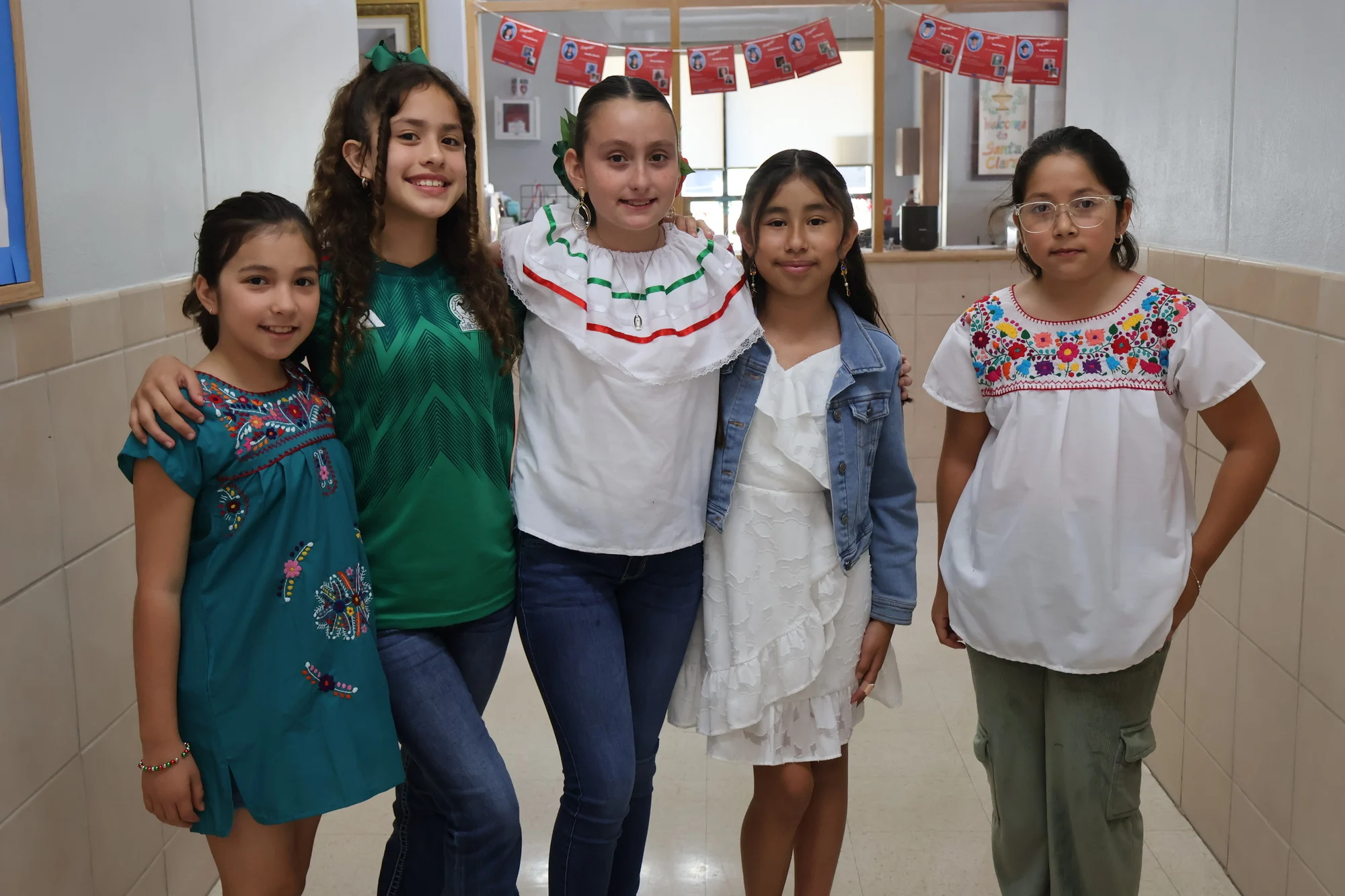
- Native English and Native Spanish students in the same classroom achieving academic excellence and bilingual proficiency.
- Content based language acquisition
- Environment that promotes linguistic and ethnic equality for positive cross-cultural attitudes
- High-level academic skills
- Improve students' career options with bi-literate and bilingual skills
- Build family-school partnership to ensure student success
- Develop strong thinking and reasoning skills in math and reading
Curriculum Breakdown
Math-English 100%
English Language Arts 50%
Spanish Language Arts 50%
Religion- English 50%, Spanish 50%
Social Studies, Science- Spanish 100% with English Reinforcement
Bilingualism: Development of high levels of oral proficiency in the student's first and second language
Bi-literacy: Perform at or above grade level in academic areas in both languages
Multiculturalism: Demonstrate positive cross-cultural attitudes, behaviors, and high levels of self-esteem
Family Involvement
Family involvement is an important and essential component to the program and its success.
Families become active in their child's education through at home assignments, school programs, and online videos.
Research and Support
Dual Language education is backed by decades of research. Here are a few key resources on how it works and why it benefits students:
The Rich Promise of Two-Way Immersion
Kathryn J. Lindholm-Leary, Educational Leadership, 2004
Explains how two-way immersion classrooms build both language skills and academic achievement for native English and native Spanish speakers alike.
The Multiple Benefits of Dual Language
Virginia P. Collier & Wayne P. Thomas, Educational Leadership, 2003
Research showing the long-term academic advantages Dual Language students gain over students in other program models.

.png)

.png)